
One day, I was looking for something and discovered several interesting events. I couldn’t dismiss these events as nothing but something. The articles in this blog post tell the story of a man. I never knew him and I am not related to him. As I read these articles and began to research this story, I found I had more questions than answers.
I was looking through old newspaper articles one day and I happened to run across this article. It didn’t mean that much to me because I had no interest in the James brothers or their activities. As I read this article something very shocking to me appeared at the bottom of this newspaper clipping. It mentioned Delaney Brumley, which was the third wife of my great-great grandfather Willis Brumley.
Delaney Foster Harris Brumley is a woman I have been chasing since 1983. She disappeared after 1891 along with Willis. It was like they both dropped off the face of the earth! Willis must have died sometime between 1899-1990. I have been to the cemetery in Maries County, Missouri to see his tombstone. It is not clear if there is a date or not because I could not make it out.
Delaney is nowhere to be found after 1880. I don’t know if she remarried again and moved out of the area or she died somewhere unknown. She was not buried near Willis, so it makes me think she moved on after his death.
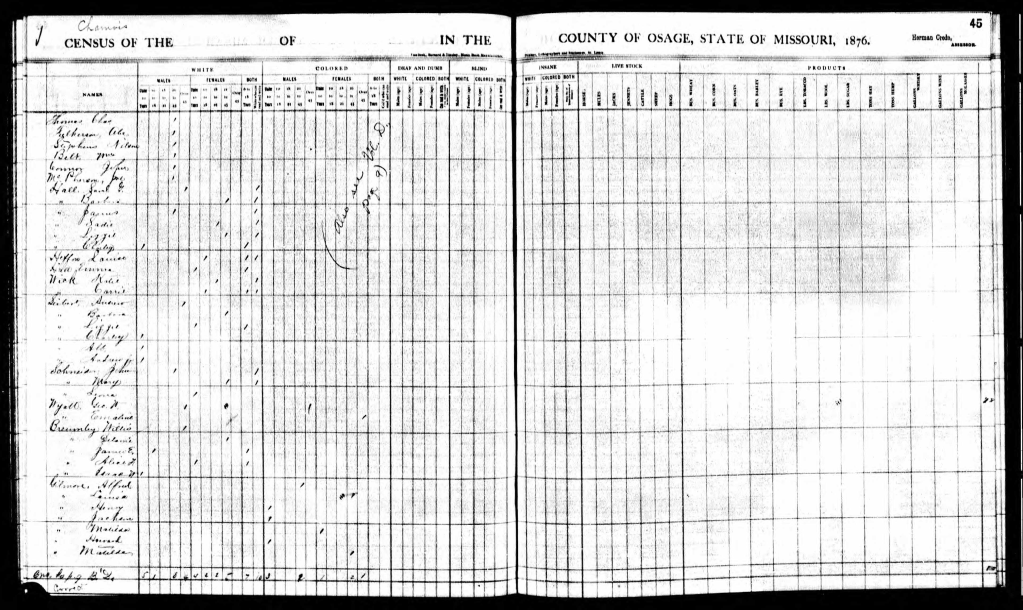
The article shows that the name is spelled Bramley, not Brumley. Yet, it correctly states where Willis and Delaney were living at that time. The 1876 Missouri Census shows them living in the same place that William Foster talks about in the article. She might have gone to live out the rest of her life with one of her children, if she had any children.
Jefferson City, Missouri • Fri, Jul 7, 1876, Page 8
The Murderer William Foster
One of the Kansas City Fair Robbers, and a member of the James Brothers’ Gang
The St. Charles Cosmos of the 21st contains the following which was related to one of the editors of that paper by Foster the murderer. He was recently hung at Warrenton, Missouri, confined in the St. Charles jail last January, a person of which will show a vast difference between it and his last statement:
Foster’s Story
I was born in Callaway County, Missouri, Oct 15, 1849. My father was a farmer, and a poor man. I went to school four years and then was apprenticed to a machinist: I worked in Dayton, Ohio, St. Louis, and other places, until the war broke out. Bounty jumping promised better wages than I could make in a shop. Afterward, I became successful in that field. I went South in 1863; I joined the Texas Rangers and served twelve months under John B Branham. I then enlisted in Bill Anderson’s command and served with him and Price until the close of the war. I wandered about the country until June 26, 1866 – doing odd jobs here and there, making a living as best I could without working – when I went to Hickory County, where I met the James crowd, several of whom I served with in the army. They have lots of hiding places, but at that time their principal rallying point was in the southwestern part of the county. Their roost is a cave, situated in wilderness of rocks, trees and underbrush, the principal apartment is large enough to hold a thousand men. The entrance will admit a man on horseback, but it is concealed by a high embankment, and few people would suspect – except in winter, when the leaves are off the trees, and when nobody frequents that section – where it leads to. There is a small aperture in the rear end of the cave, where we sometimes went out, but it is rough and dangerous, and resorted to an emergency. We had a small, rifled cannon mounted in the cave, about twenty feet from the entrance, and with that we felt able to resist a pretty large force – at least until we could make our escape through the hold at the other end. Here we made our plans for the campaign, brought our plunder, and rested from the weariness of expeditions that were sometimes long and harassing.
The first one I joined was to Little Rock. At this place twelve of us blew a safe, and got back to the cave with $12,000 – a clear thousand apiece. Out next excursion was to Burlington, Iowa. There were thirty of us in town and on the outskirts – enough to get away with the best home guard company in the state. We made a raid on the bank there in broad daylight, getting away with $2,700. Only three of us did the work. We rode up within a few doors of the place and dismounted. One held the horses, while the other two went in and “took possession.” The cashier was “game,” but with twelve pistol barrels to look into, he lost the power of speech instantly, and we had it all our own way. We were partial to banks, and as a general thing didn’t bother anything else. Thirteen of us went to Quincy and stayed a month, working up a raid that finally netted us $15,000 in greenbacks, and a few hundred in “chinkers”. Here we separated. Three of us went to Summerfield, Illinois, and after working all night on a safe, got it open, but only found a few dollars in it, which we threw back in disgust. Shortly after this the ten whom we parted from Qunicy joined us in St. Louis, where we stayed a week. Two bands were organized – and go to Hermann and the other to Union. I was with the former and shared the profits, which were only about $1,700. The Union party, I heard, got about $600. After these affairs we all returned to Hickory County and stayed a month.
Two expeditions were then fitted out, one for St. Charles and one for Louisiana. I went with the latter crowd. It was our intention to raid both towns at the same time but the boys who came to St. Charles did the thing up in such a hurry and so slick, that it was all over before we got the river. We finally succeeded and came together again about thirty miles above Louisiana, on the Missouri side. Two of us went down to Mexico and worked three hours on a safe but had to give it up in disgust.
The liveliest experience of my life was at Kansas City, during the fair. Three of the boys fired their pistols, which attracted the crowd from the gate keeper and made a forced loan. We all escaped, changed our clothing, and in an hour were back in the grounds, gazing at the big pumpkin and green horns. At Boonville, a few months after the Kansas City affair, we came near getting gobbled. Three of us were in the barber shop, about 9:00 am in the morning, getting shaved, when a citizen came running in with news that the James boys had been seen about a mile from town, and that a company of scouters was being raised to go after them. The barber was frightened almost out of his boots, but he finally got through with us, and we were not long in getting out of that burg. We abandoned our horses, swam the river and about four miles on the other side raided a country store, getting a change of clothing, which we needed bad enough.
Eight of us then went over into Kansas, but after several unsuccessful attempts to turn and honest penny, came back to Missouri poorer than when we left. Although we didn’t get anything in that State, we were followed to Rock Port by a gang of about a dozen men, one of whom shot Jim Lane, of our party in the thigh, from which he afterwards died.
Near Columbia we entered the house of a man named Burkhardt, taking a few articles of value, and then went to a dance that was going on in town and raised hell.
In the fall of 1872, nine of us took up our residence in Keokuk. There I came near getting my everlasting. In blowing a safe we used a white powder of our own make, and while my partner was ramming it into the hole with the butt end of a cold chisel, it prematurely exploded, throwing him clear across the room, and nearly blinding me. We escaped from the building and the town, leaving our arms and horses behind, and secreting ourselves in the woods all night from the police, who were in hot pursuit.
Most of us got horses the next day and returned by various routes to Hickory County, October 14, 1875, a party of us made a friendly call upon the Saving Banks at Fulton, but were not cordially received. I got shot in my hat, and one of our boys, who hand killed a man and joined our party for protection, was captured and put in the Callaway jail. We took him out in November, and he is now in Cuba, Mo. Soon after this we went to Leavenworth and remained a week.
The” Boss” was with us and managed the job. He went to one of the banks on day, exchanged bills for specie, and took in the situation. Next day the “Boss,” George Saunders and I stepped behind the counter, the “Boss” holding a pistol to the cashier’s head while George and I gathered up the loose cash. The police made it hot for us there, and we got out in a hurry, going to Topeka, where we succeeded in relieving a big store of about $7,000 worth of surplus goods. We were pursed by a lot of vigilantes from Topeka, who killed one of our men – Billy Byers – or rather wounded him so that he died before we got him home. Twelve of our boys did the Gad’s Hill business: I was selected to go with them but got sick and remained in Hickory County.
I was married in Fulton, in February 1871, to Miss Durieux, by Squire Griffy, and have one child, a boy, born March 4th, 1873. My mother is now living with her second husband, Delaney Bramley, two miles from Chamois, Osage County. My wife and child are poor, but when I am gone, they will be provided for, and it’s nobody’s business how. I fixed that before I got into this scrape. I have led a hard life, been in a good many scrapes, but never killed a man before. If everybody would do as I have done, this wouldn’t be such a” dammed negro-equality country.”
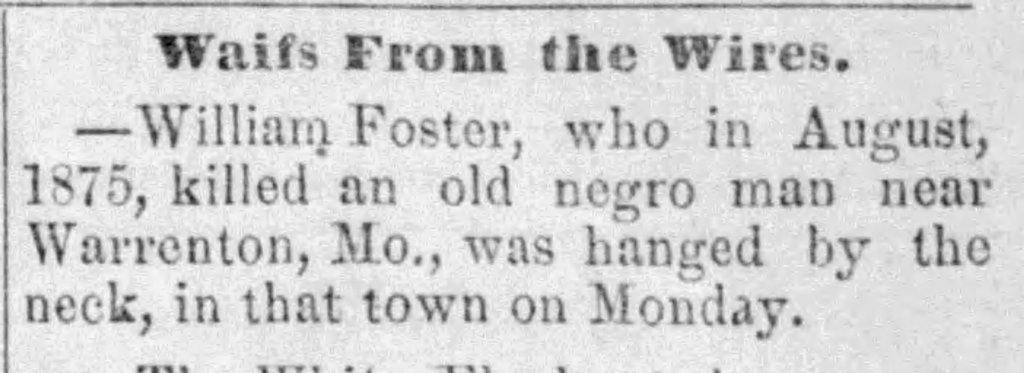
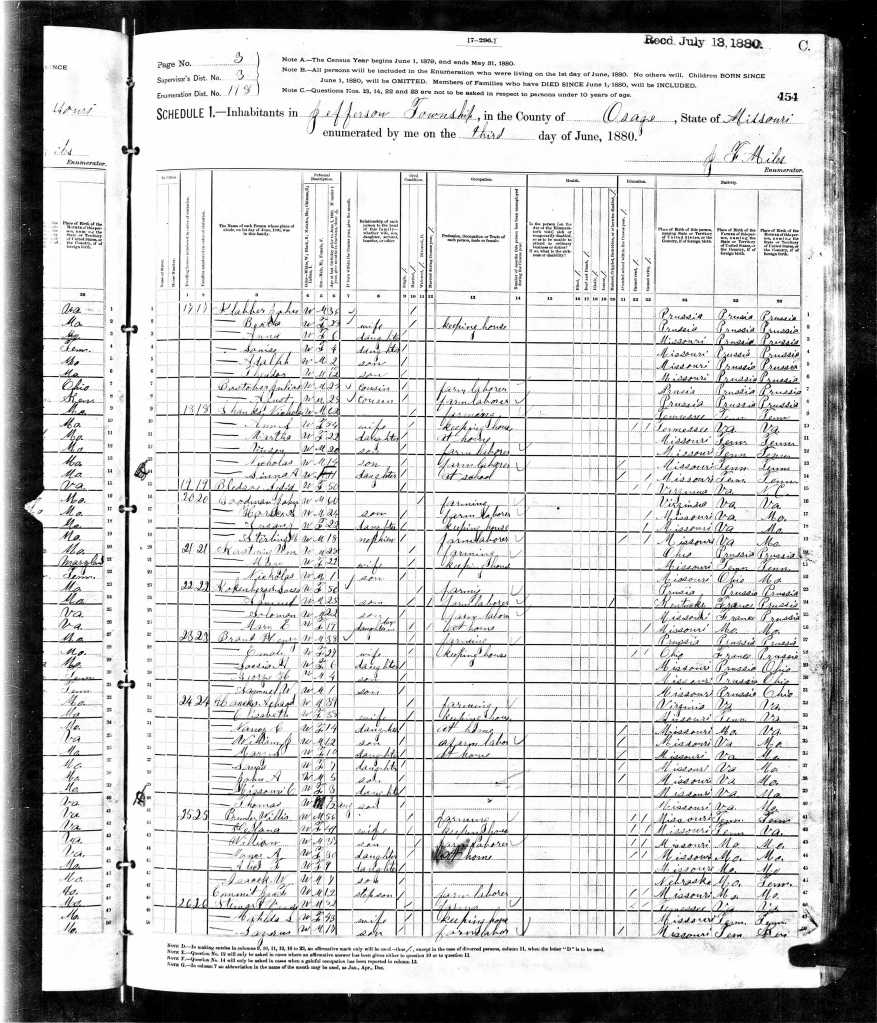
What I do know about Delaney Foster Harris Brumley is that she was born about 1831 in Missouri as of the 1880 Census of Missouri. She married for the first time in Callaway County, Missouri and had William in 1849. She married for the second time to Charles Harris in 1871 in Osage County, Missouri. Delaney married for the third time to my great-great grandfather on February 22, 1874, in Osage County. There were no children that I know of from this union. This is where the trail goes cold.
Thank you for reading this blog post.
 Brumley Family Branches
You must be logged in to post a comment.